Have you ever felt shaky, irritable, anxious, exhausted, or suddenly overwhelmed when you haven't eaten in a while? Maybe you've noticed that your anxiety seems worse after certain meals, or that you experience an afternoon energy crash that leaves you feeling like your brain has stopped working. Perhaps you struggle with chronic fatigue, feel tired but wired, need to nap every single day, or find that your capacity to handle everyday stress seems to fluctuate throughout the day.
We tend to think of these experiences as separate problems. We might attribute the anxiety to our mental health, the fatigue to poor sleep, and the irritability to stress. But what if some of these experiences share a common contributor?
One piece of the puzzle that deserves more attention is blood sugar regulation, particularly the way our glucose levels rise and fall throughout the day. As a holistic therapist and Certified Integrative Mental Health Professional, I believe understanding the connection between our physical health and mental health can help us make sense of symptoms that might otherwise feel confusing. Glucose regulation is one example of how something happening inside the body can influence how we feel emotionally, mentally, and physically.
Your Brain Needs Energy to Function
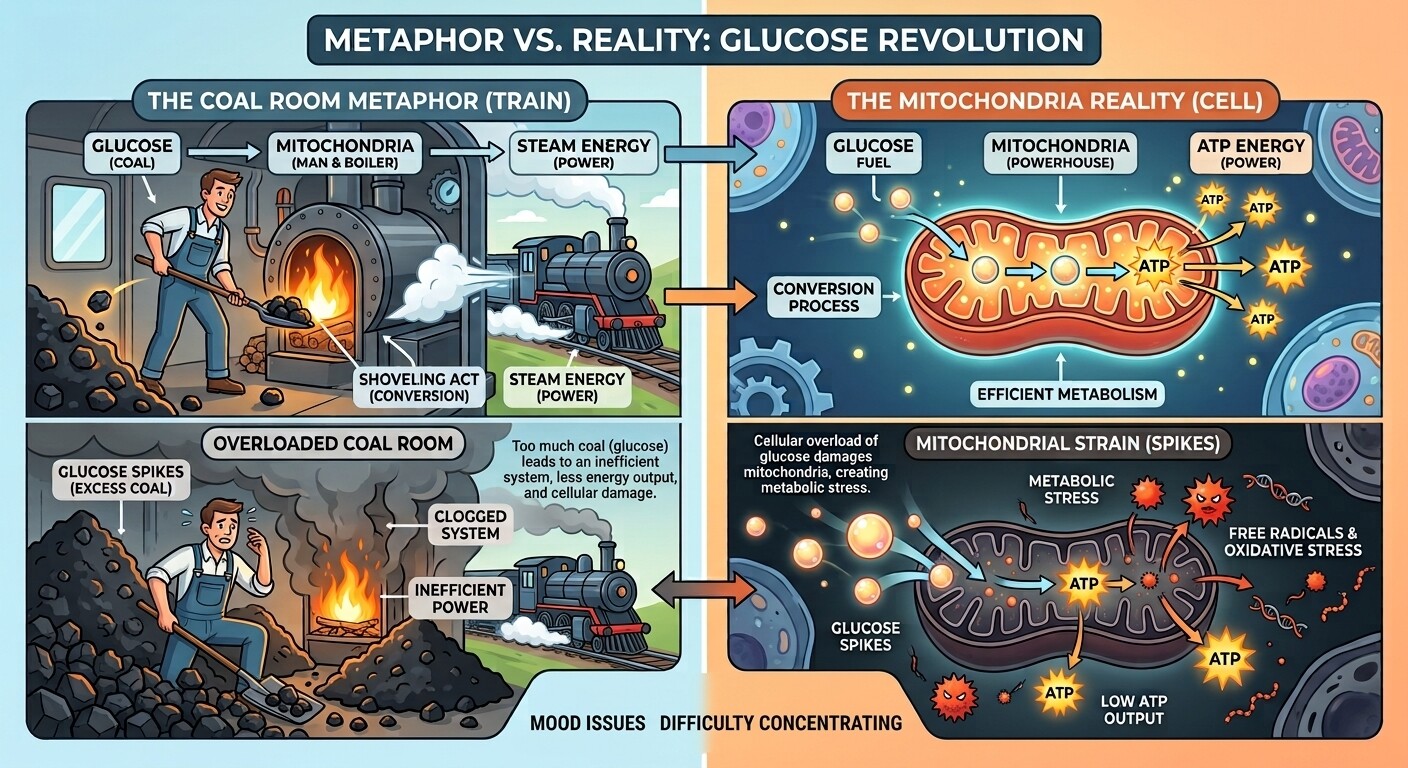
Your brain is an incredibly energy-demanding organ. It relies heavily on glucose for fuel under ordinary conditions, and the work of thinking, concentrating, processing emotions, and responding to stress all requires energy. That energy is produced through a series of processes inside your cells, many of which involve the mitochondria. You may have heard mitochondria described as the powerhouses of the cell. Their job is to help convert the energy available from nutrients into a form your body can use.
I love the way Jessie Inchauspé explains this process in her book Glucose Revolution. She uses the analogy of a person working in the coal room of a train, continually shoveling coal into a fire to keep the train moving. Think of glucose as the coal and your mitochondria as part of the machinery that helps turn that fuel into usable energy. But imagine what happens when the man in the coal room is being given more coal than he can effectively manage. Coal starts piling up around him. He can only shovel so much into the fire at a time, and the room becomes increasingly crowded. The system is no longer running as smoothly as it could.
This is one way to think about what can happen when your body is repeatedly exposed to large glucose spikes, particularly when glucose regulation is already impaired. When more glucose is available than your cells can efficiently process, the excess can contribute to metabolic stress, including the production of free radicals and oxidative stress. Over time, these processes can interfere with healthy cellular function, including the mitochondria's ability to produce energy efficiently. And when your energy systems are under strain, you may notice the effects in places you wouldn't necessarily expect, including your mood, concentration, and ability to cope with stress.
What Happens When Your Blood Sugar Spikes and Drops?
When you eat carbohydrates, your body breaks them down into glucose, which enters your bloodstream. Your pancreas releases insulin to help regulate blood glucose and facilitate its uptake into tissues. This is a normal and necessary process. Blood glucose naturally rises and falls throughout the day, and a rise after eating is not inherently a problem.
The concern is that some people experience larger or more rapid fluctuations than others. Depending on the meal, your individual physiology, and other factors, glucose may rise quickly and then fall significantly afterward. In some circumstances, glucose can drop to a level that is too low, a condition known as hypoglycemia. Other people experience symptoms during a rapid decline even when their glucose remains within the "normal range." This is why glucose variability is worth considering when you are trying to understand recurring changes in energy, mood, and physical sensations.
Think about what happens when your energy suddenly drops. You might become shaky, irritable, foggy, weak, or unusually anxious. I personally have experienced this, and it is a terrible feeling. Your patience may disappear. A minor inconvenience can feel disproportionately overwhelming, and a task that seemed manageable an hour ago may suddenly feel impossible.
For some people, these experiences are connected to the body's response to falling blood glucose. When glucose becomes too low, the body activates counterregulatory responses, including the release of hormones such as adrenaline and cortisol, to help restore glucose availability. Adrenaline can produce symptoms such as trembling, sweating, a racing heart, and feelings of anxiety.
If you've ever experienced a sudden wave of physical anxiety that seemed to come out of nowhere, you can understand how confusing this might feel. Your body may be producing sensations that resemble a stress response, even when nothing particularly stressful is happening around you. And if you're already living with anxiety or a sensitized nervous system, those physical sensations can be especially uncomfortable. A racing heart or shaky feeling may be interpreted as a sign that something is wrong, which can create another layer of distress.
This does not mean that every episode of anxiety is caused by blood sugar. Anxiety has many possible contributors, including psychological stress, trauma, sleep disruption, hormonal changes, medications, and other medical conditions. But metabolic factors can be part of the picture, and they deserve consideration when the pattern fits.
The Connection Between Blood Sugar and Nervous System Dysregulation
Your nervous system is constantly gathering information about your internal and external environment. It responds to perceived threats, helps regulate essential bodily functions, and works to maintain a state of balance. When you have a history of trauma, chronic stress, or prolonged periods of feeling unsafe, your nervous system may already be more reactive to changes in your body. You might notice that your heart races easily, you struggle to settle down at night, or your tolerance for everyday stress is much lower than it used to be.
Now consider what happens when physical symptoms such as shakiness, a racing heart, irritability, or sudden fatigue enter the picture.
These sensations can add to the body's overall stress load. If blood glucose is falling rapidly, your body may release stress hormones in response. Those hormones can create physical sensations that resemble anxiety, making it more difficult to distinguish between an emotional stressor and a physiological one.
For someone who already feels tired but wired, this can be particularly frustrating. You may desperately want to relax, but your body feels activated. You might feel exhausted while simultaneously struggling with restlessness, tension, or an inability to settle into sleep. Blood sugar fluctuations are only one possible contributor to this experience. But understanding that physical processes can influence nervous system states helps us take a more comprehensive approach to regulation. Mental health and physical health is a bi-directional relationship.
We can work on the psychological and relational factors that contribute to stress while also paying attention to the body's basic needs, including adequate nourishment, sleep, and metabolic health. Sometimes, supporting the nervous system means looking beyond breathing exercises and grounding techniques to ask whether the body has what it needs to feel physically stable.
Could Glucose Variability Contribute to Anxiety, Depression, and Chronic Fatigue?
The relationship between glucose regulation and mental health is complex, and research continues to explore how metabolic health influences mood and cognitive functioning. There is evidence of associations between metabolic dysfunction and conditions such as depression, but these relationships are multifaceted. We cannot assume that glucose fluctuations alone cause a particular mental health condition, or that correcting glucose levels will resolve it. Even so, there are several connections worth understanding.
Anxiety. Rapid changes in blood glucose, particularly when accompanied by a drop in glucose, can produce physical sensations such as trembling, sweating, palpitations, and nervousness. These sensations can intensify existing anxiety or make it difficult to identify what is driving a particular episode. For some people, noticing a pattern between eating, physical symptoms, and anxious feelings may offer a useful starting point for further investigation.
Depression and mood changes. Metabolic health and depression have been associated in research, although the direction of the relationship is not always clear. Depression can influence sleep, appetite, activity, and eating patterns, while metabolic and inflammatory processes may also play a role in mood for some individuals. Blood sugar variability is one possible piece of a much larger picture. It should not be treated as a standalone explanation for depression, but instead as a factor that may be contributing to or exacerbating it.
Chronic fatigue and brain fog. Your body needs energy to sustain attention, memory, physical activity, and everyday functioning. When glucose regulation is impaired, some people experience fatigue, weakness, or difficulty concentrating. However, persistent fatigue can have many causes, including thyroid dysfunction, anemia, sleep disorders, medication effects, chronic illness, and other metabolic conditions. If you are constantly exhausted despite adequate rest, it is worth exploring the underlying contributors rather than ignoring these cues.
Stress tolerance. When you're already depleted, ordinary stressors can feel much more difficult to manage. Hunger, inadequate nourishment, poor sleep, and physical discomfort can all reduce your capacity to cope. If glucose fluctuations contribute to those experiences, improving the consistency of your nourishment may help support your overall well-being, alongside appropriate medical and psychological care.
The thyroid-mitochondria-mental health connection. Funtional medicine provider Dr. Sam Shay discussed another interesting piece of this puzzle: the relationship between mitochondrial function and thyroid health. In his recent podcast conversation with Dr. Izabella Wentz, he describes how the two systems are interconnected and proposes that when mitochondria aren't functioning efficiently, the body may downregulate thyroid activity in response.
The idea is that thyroid hormones help regulate cellular energy production, while mitochondria are responsible for producing much of the energy our cells need. When energy production is impaired, the body’s thyroid signaling and metabolism may also be affected. In this model, what looks like a thyroid problem may be connected, at least in part, to a broader issue with cellular energy production.
This connection matters because... what is a common symptoms of hypothyroidism? Depression. (https://www.mayoclinic.org/diseases-conditions/hypothyroidism/symptoms-causes/syc-20350284)
When you're already struggling with low energy or mood changes, it can be helpful to consider whether metabolic or thyroid-related factors are contributing alongside psychological stress. Dr. Shay's proposed model is one way of understanding this relationship, although mitochondrial dysfunction is not an established universal cause of hypothyroidism, and thyroid conditions require appropriate medical evaluation.
All of the above listed connections matter because mental health does not exist in isolation from the rest of the body. Our experiences are influenced by a combination of biological, psychological, social, and environmental factors. Looking at only one part of that picture can leave important questions unanswered.
We Have to Consider the Body When We Work on the Mind
As a therapist, I often think about how much we ask people to do psychologically while overlooking the physical conditions they are trying to function within. We ask people to regulate their nervous systems, challenge anxious thoughts, practice mindfulness, and build emotional resilience. These approaches are valuable. If I didn't believe in them, this wouldn't be my career! But it is also worth asking whether someone is sleeping adequately, receiving enough nourishment, dealing with an underlying medical condition, or experiencing physiological symptoms that make emotional regulation more difficult.
If your body is struggling, you may find that the work of managing your mental health feels harder than it needs to be. That does not mean therapy is ineffective or that you are doing something wrong. It means your body needs attention, too.
This is one reason I take a holistic approach to mental health. We can explore your experiences, relationships, thought patterns, and nervous system responses while remaining curious about the physical factors that may be contributing to how you feel.
Sometimes, the most helpful next step is a new therapeutic skill. Sometimes, it is a conversation with a trusted physician about your fatigue or other symptoms. And sometimes, it is recognizing that these pieces may be connected and deserve to be explored together. You deserve care that takes your whole experience seriously. At my practice, I frequently refer to holstic providers within my trusted referral network to look into possible root causes (and/or exacerbators) of your mental health symptoms.
A Few Important Notes
My role as a therapist. I am a licensed mental health therapist, not a medical provider, and I cannot diagnose metabolic conditions or determine whether glucose variability is contributing to your symptoms. Mental health is frequently influenced by physical health, which is one of many reasons I believe we need to consider the body when working on the mind.
Educational purposes only. This article is intended for general educational purposes and is not medical advice. It is not intended to diagnose, treat, or prevent any medical or mental health condition. Please consult an appropriately qualified healthcare professional about your individual symptoms and concerns.
Finding the right support. When appropriate, I frequently refer clients to holistic and functional medicine providers, as well as qualified registered dietitians, who can help evaluate metabolic health in the context of the whole person. Depending on your circumstances, this may include reviewing symptoms, medical history, glucose regulation, and relevant laboratory results. Some practitioners also consider narrower, evidence-informed target ranges rather than relying exclusively on whether a result falls within a laboratory's reference interval. However, optimal targets vary by test, clinical context, and individual health needs, and a result outside a preferred target does not automatically indicate disease. The goal is to find a knowledgeable provider who can help you interpret your results thoughtfully and determine what, if anything, needs further attention.
If you’re an adult in Ohio who values a holistic approach to mental health, I’d love to connect with you. At Soma & Soul, I believe our mental health is deeply connected to our physical health, lived experiences, and the environments we move through every day. Therapy can be a space to explore these connections, better understand your nervous system, and develop a more compassionate relationship with yourself. If this approach resonates with you, I invite you to learn more about my services and reach out to see if we might be a good fit.